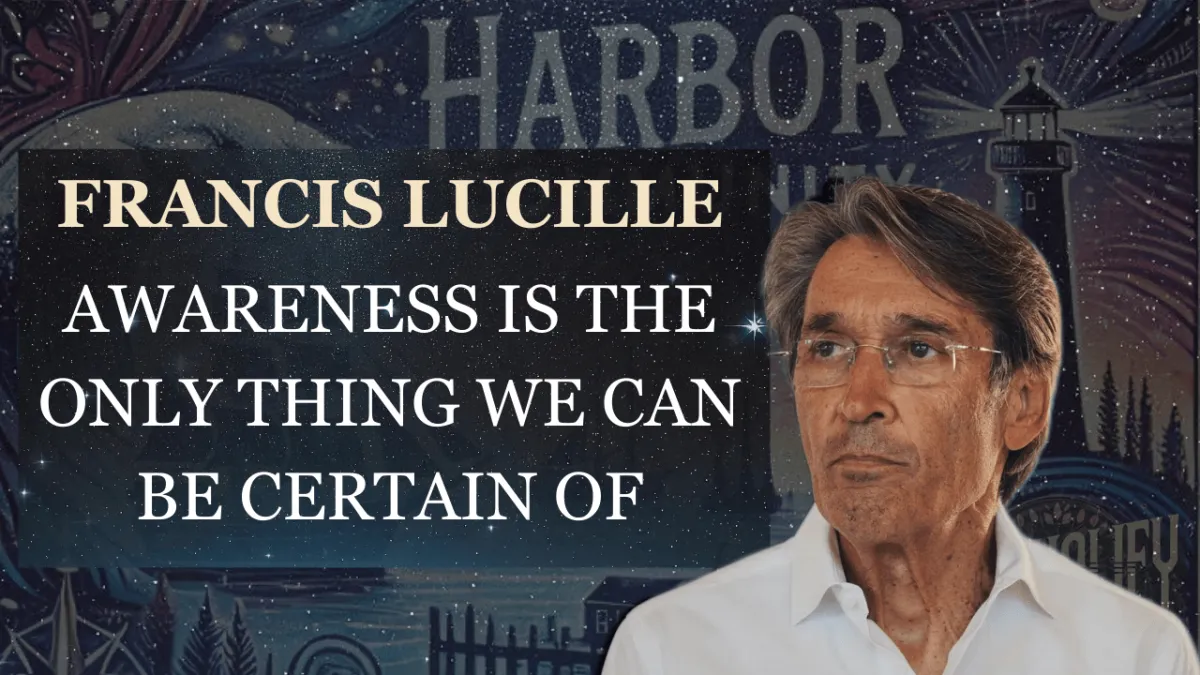
Exploring Non-Duality: A Dialogue with Francis Lucille
Introduction and Welcome
Olli: Hi, everyone. Welcome to this Monday evening webinar, where we have the pleasure of speaking with Francis Lucille. Thank you, Francis, for joining us on short notice. Although many of our audience members are familiar with your teachings, there are some who may not have heard of you before. Could you start by briefly sharing a bit about yourself and your teaching?
Francis Lucille’s Background and Journey
Francis Lucille: Well, I can share a bit, though it’s not really about myself. This body was born during World War II, became an engineer, married, had a child, and realized that although it was successful by society's standards, it had still led to a life of misery.
Eventually, I came across teachings from Krishnamurti, which revealed the possibility of a solution to this suffering. I began studying Buddhism and non-dual scriptures, and I came to realize I needed a teacher. Then, a teacher appeared—Jean Klein. This was in 1975, and from that point on, life took a beautiful, harmonious direction.
Olli: Thank you.
The Shift from Atheism to Higher Teachings
Olli: I remember you mentioned that you were raised with an atheist perspective, and you initially appreciated Krishnamurti because of his alignment with atheism. But over time, you moved towards what you called “the higher teachings.” Can you speak to whether non-dual understanding requires a specific belief?
Francis Lucille: Quite the opposite; it’s not about belief. Non-duality isn’t a religion, and in fact, it’s very minimalist. It revolves around one question: Can we live our lives based solely on what we can be absolutely certain of? For example, we can’t be entirely sure there’s a world out there, because in dreams, we’re unaware that we’re dreaming. Right now, this could also be a dream. So, we cannot be certain of the reality of what we perceive—whether it’s trees, houses, or anything else.
However, one thing is absolutely certain: the awareness of the experience itself and the existence of something rather than nothing. These are two certainties: I am and I am aware. Everything else remains uncertain.
The Nature of Philosophy and Knowledge
Francis Lucille: So, what’s the purpose of philosophy? It’s not about accumulating knowledge—we have science for that. The famous physicist John Wheeler once said, “Philosophy is too important to be left to philosophers,” meaning that science is better equipped to handle concepts like time and space. The true purpose of philosophy, especially ancient philosophy, is to explore how to live a harmonious life.
The question, then, is: Can we live based solely on what we know for certain and remain in a state of openness regarding everything else? This doesn’t mean we ignore practical knowledge—such as knowing how to drive or use a computer—but when it comes to life’s fundamental questions, these tools are irrelevant. This is where philosophy steps in: it’s about living a harmonious and happy life, based on the certainties we can directly experience.
The Path of Non-Duality and Certainty
Francis Lucille: Non-duality suggests that to live harmoniously, we need to base our lives only on what we know for certain and stay open about the rest. This approach has been shared by sages from different traditions—Sufis, Buddhists, Taoists, Greek philosophers, and even modern thinkers like Spinoza. Each of these traditions emphasizes harmony and happiness as achievable through an understanding of fundamental truths.
Certainty of Awareness vs. Perception
Olli: An ordinary person might question why you consider awareness or “being aware of being aware” the only thing we can be certain of. Why is this the case?
Francis Lucille: Because everything else is indirect. For instance, when you see a tree, you’re actually perceiving an image of it. If we both look at a tree, we each see our own version of it, meaning we don’t actually see the tree itself but rather a perception of it. Direct experience is limited to the perception, while the tree itself remains unseen.
Direct Knowledge of Consciousness
Olli: So, how is this direct awareness or consciousness different from perceiving a tree?
Francis Lucille: The question is, how do we know that we’re conscious? Is it something we learned, or is it based on an experience that’s entirely certain? Unlike seeing a tree, consciousness knows itself directly—it doesn’t require sight, sound, or touch. It’s the only thing we know firsthand, making it the only thing we can be absolutely certain of.
Addressing the Experience of Awareness in Anesthesia and Coma
Olli: How would you explain awareness in situations where we lose ordinary consciousness, like under anesthesia or after a head injury? Many people see this as evidence that awareness ceases.
Francis Lucille: Let’s first consider last night’s sleep. Do you remember much of it? No. But does that mean you weren’t conscious? No. Lack of memory doesn’t imply unconsciousness.
If someone claims there’s no awareness during deep sleep or anesthesia, they can only do so as an educated guess. They have no direct experience of an absence of awareness, because an awareness of absence would still be an awareness. Therefore, any claim that awareness was absent in such states lacks experiential evidence.
First-Person vs. Third-Person Definitions of Consciousness
Francis Lucille: There are two perspectives: third-person, such as the doctors observing a patient in a coma, and first-person, like the patient’s subjective experience. The third-person view doesn’t give us insight into the first-person experience, which is what truly matters to us. The experience of consciousness is immediate and self-aware, and it doesn’t necessarily have a beginning, end, or limitation as the third-person perspective might suggest.
The Timeless Nature of Consciousness
Francis Lucille: Ultimately, we know that we are, but we don’t fully know what we are. This not knowing is actually a pointer towards the boundless, eternal nature of consciousness. It points to consciousness as universal, and in religious terms, even divine. This recognition allows us to understand that consciousness itself is infinite and unconfined, beyond anything that the third-person perspective can capture.
Recognizing the Continuity of Consciousness
Olli: I recall when I first encountered Ramana Maharshi’s teachings and realized with absolute certainty that I didn’t disappear in deep sleep. This brought me to understand the continuous field of awareness. I hadn’t yet fully realized the universality of consciousness, but I deduced logically that, if this awareness never begins or changes, the sages who claim consciousness is universal might be onto something. I also learned from you the importance of acknowledging that “I don’t know what I am,” before trying to assert universality. Could you discuss the significance of this second step, “I don’t know what I am,” and what it opens up for us?
Francis Lucille: Many people want to experience their universality tangibly—they want to see it, hear it, or feel it, perhaps as some special power. But if we could perceive universality in this way, it would be limited and, therefore, not truly universal. Our true universality, if it is unlimited, must remain invisible. This means we are both nothing and everything. We can never be “something” and still be everything.
Consciousness as the Reality of Experience
Francis Lucille: Another key point is understanding that there is only one reality. Reality, or consciousness, is the constant in our human experience—it’s always present when our experience is present. Our body, for instance, isn’t a candidate for our ultimate reality, because it disappears at times, like when we’re deeply absorbed in a book, dreaming, or under anesthesia. Consciousness, however, is ever-present and therefore the true reality of our human experience.
Our human reality interacts with the world through perception and action, establishing a connection. This interaction indicates that the reality of our being and the reality of the world are one and the same. There is a single, shared reality that is experientially evident.
The Intuitive Experience of Oneness
Francis Lucille: This oneness is something we intuitively feel, even without philosophical or scientific knowledge. We sense an interconnectedness, a wholeness of life and the universe. If there is only one reality, then the reality we experience as consciousness must also be the reality of the world and all beings. This shared reality is what we experience as love—an intuitive recognition that “I” and the “other” share the same essence.
The Connection of Love and Beauty
Francis Lucille: Love is the feeling of sharing the same reality with others, while beauty is the sensory experience that the world is our body. This is evident in the way art touches us, erasing borders between ourselves and what we perceive. For example, in Cezanne’s paintings, he often leaves part of the contour open, symbolizing that nothing is closed off or separate. This openness allows everything in the artwork to merge together, reminding us of the interconnectedness and oneness of all things.
Consciousness and the Pursuit of Happiness
Olli: Given this understanding of shared consciousness, what does this have to do with happiness and living well?
Francis Lucille: The primary obstacle to happiness is our fear of absolute disappearance, inherited from both our genetics and our cultural surroundings. As human beings, we have survival mechanisms that create a chronic state of alert when we identify with the body. Unlike animals, who return to stillness after a threat has passed, our capacity to project into the future can keep us in a constant state of fear.
This fear stems from our identification of consciousness with the body, which is bound to perish. When we recognize that consciousness is not limited to the body, this chronic fear dissipates.
Liberation from Fear: Living Without the “Party Pooper”
Francis Lucille: Imagine life with and without the “party pooper”—the fear of disappearance. Like a teenager who wants their parents to leave the house to enjoy a party, we want this fear to leave us so we can live freely. When we no longer identify with the body, the party pooper—the fear of our end—vanishes, allowing us to fully experience the joy of living. Life, then, becomes a celebration without the fear of an abrupt end.
Olli: Many might argue that they’re more concerned with day-to-day issues, like not having enough money or not achieving certain goals, rather than with fear of disappearance.
Francis Lucille: To address that, I could ask them: If these issues were truly all you feared, then wouldn’t ending your life also end those worries? But, of course, that’s not what anyone truly desires. This response reveals the deeper fear at play—the fear of nonexistence. Every desire for success or security ultimately traces back to a fear of being left alone, unloved, and unprotected, facing the inevitability of death. We mask this core fear with more immediate concerns, but in essence, it’s always about our fear of disappearance.
Navigating from Openness to Universal Understanding
Olli: Given the openness in realizing “I don’t know what I am,” what are the steps, or perhaps milestones, from that openness to a full understanding of universality?
Francis Lucille: There are two paths: the direct path and the phenomenal path. We navigate both simultaneously. The direct path involves glimpses of consciousness in which we directly experience its boundlessness. In each glimpse, we realize that consciousness is not only our reality but also contains absolute happiness, love, intelligence, and beauty. These qualities are not experienced in a sequence but as an all-encompassing awareness in a single moment.
The phenomenal path, on the other hand, is our experiment of living life from the perspective that consciousness is universal. Each time we act from this vantage point, both the world around us and our inner experience respond harmoniously, increasing serendipity and happiness. Gradually, we accumulate evidence that consciousness is universal.
In the direct path, we gain a direct, immediate knowing of universal consciousness with each glimpse. In the phenomenal path, by engaging with the world—our relationships, thoughts, sensations, and perceptions—we find increasing harmony, both externally and internally, affirming the universality of consciousness over time.
Embracing Universal Consciousness in Daily Life
Olli: If we accept that consciousness is universal and we try to live our lives with this understanding, it often requires courage. For me, it wasn’t enough just to practice self-inquiry; I had to play the role, to embody this realization, which brought more clarity and depth. Courage, I believe, allows these insights to prove themselves.
Francis Lucille: Absolutely. When we live from the understanding of our universal being, beyond the fear of death, everything we encounter becomes a reflection of presence—peace, love, happiness, and beauty. Objects, situations, and relationships point us back to the underlying presence that is beyond words or imagination. It’s a different way of engaging with life. This new perspective even seems to change upcoming events, confirming the universality of consciousness, as if reality itself affirms our path with a sense of alignment.
On the Use of the Term “God”
Olli: Just to clarify, you’re using “God” as a synonym for awareness or consciousness, correct?
Francis Lucille: Yes, it’s not a personal deity but rather the God of Spinoza, the reality of all things. It is consciousness itself, which is universal, impersonal, and all-encompassing.
Why Are Some Drawn to Nondual Teachings?
Olli: Why do you think relatively few people are drawn to explore this understanding? Often, suffering seems to drive people to seek deeper insights, but is there something else that qualifies or inclines someone toward non-dual teachings?
Francis Lucille: There are no strict qualifications for this inquiry. Spiritual seeking isn’t limited to intellectual prowess, physical flexibility, or health. It’s more of a mystery, as the spirit blows where it will. The important question isn’t why others are drawn to it or not but rather, “Why do I believe I am a separate entity?” When we investigate this personally, we find no solid evidence to support it. Instead, we realize ignorance is a choice, and this choice has always been optional.
Addressing Ignorance with Ease
Francis Lucille: Ignorance is not problematic from the perspective of truth. When a student comes with a sense of ignorance and considers it an obstacle, if I were to agree and say, “Yes, this is a huge problem, and only a few have overcome it,” that would reinforce a sense of limitation. But from the vantage point of universal consciousness, ignorance is not an obstacle; it’s just a passing cloud. This shift in perspective allows for a more accessible and effective transmission of understanding.
The Impact of Meeting a Teacher
Olli: Since attending your retreat, I noticed that old, entrenched habits simply faded away, seemingly without effort. Could meeting a teacher contribute to this kind of transformation?
Francis Lucille: Absolutely. In my case, I initially sought these teachings to address my shyness, but I realized that this was merely a symptom of a deeper ignorance. Once I focused on understanding my true nature, my shyness gradually dissolved without me directly working on it. Similarly, my teacher, Jean Klein, shared that after meeting his own teacher, he felt as if his life had accelerated, becoming dynamic after years of stagnation. Such profound transformations often arise naturally from this encounter with truth, making it clear that real change doesn’t require effort.
Olli: That resonates deeply with me. I felt as if the understanding was already there, but it intensified after the retreat, dissolving remaining habits and patterns.
Francis Lucille: It’s a common experience. When you’re in the presence of someone who sees you as consciousness rather than a separate being, there’s a natural alignment and acceleration of understanding. This, in turn, dissolves old patterns effortlessly.
Closing Reflections
Olli: Thank you, Francis. This was a wonderful and insightful session, and I’m sure our listeners will appreciate the clarity. I look forward to seeing you in Paris.
Francis Lucille: Thank you, Olli. See you in Paris. Goodbye.
